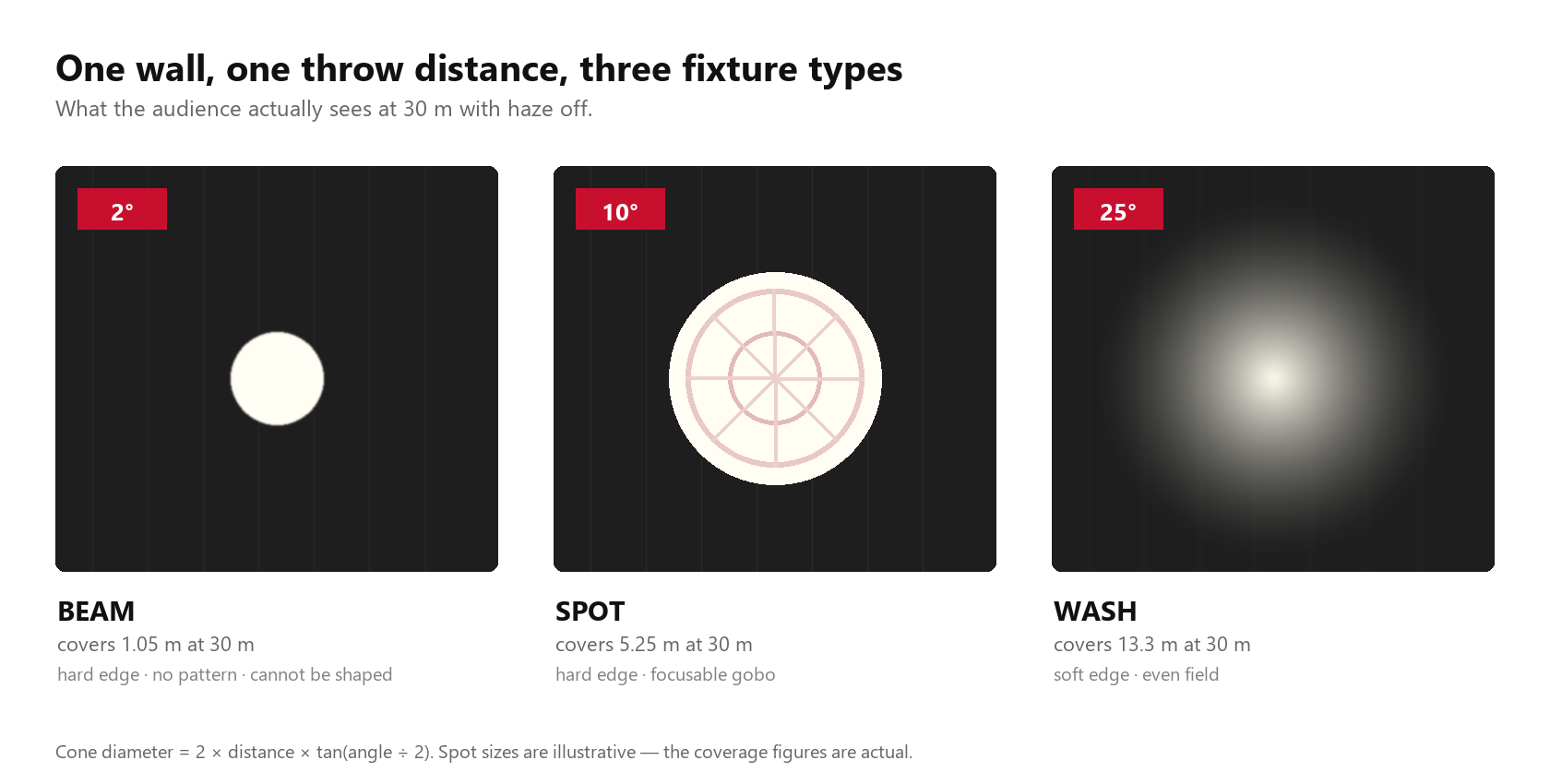
Beam, spot and wash get quoted as if they were three products. They are three points on one optical continuum, and the wrong one on the truss does not look like a badly chosen fixture — it looks like a bad fixture. Here is what actually separates them: beam angle, edge hardness, and whether the light can be shaped at all. Plus the numbers you need to pick correctly before the quote goes out.
1. The One-Line Difference
Strip away the marketing and each type has exactly one job:
- Beam — a narrow, hard-edged column. Typically 2° to 6°. It is meant to be seen as a shaft of light in haze, not to light a surface.
- Spot — a shaped pool of light. Typically 10° to 45°, usually with gobos. It is meant to put something recognisable on a performer, a wall or a floor.
- Wash — a wide, soft, even field. Typically 25° to 60°. It is meant to cover an area in colour, not to make a point.
The word that disappears from that list is shaped. A beam cannot be shaped. A wash does not want to be. A spot is defined by the fact that it can be — and everything else follows from that single difference.
If you only remember one sentence: beam makes a line, spot makes a picture, wash makes a field.
2. Three Variables That Actually Separate Them
Product names are unreliable. A "beam" from one factory can be a 6° spot with no gobo wheel, and a "three-in-one" can be a wash with a narrow zoom range bolted on. Judge a fixture by three measurable things instead.
2.1 Beam angle — and the number nobody prints
Every spec sheet lists beam angle. Almost none list field angle, and the gap between those two numbers is where a lot of disappointing rooms come from.
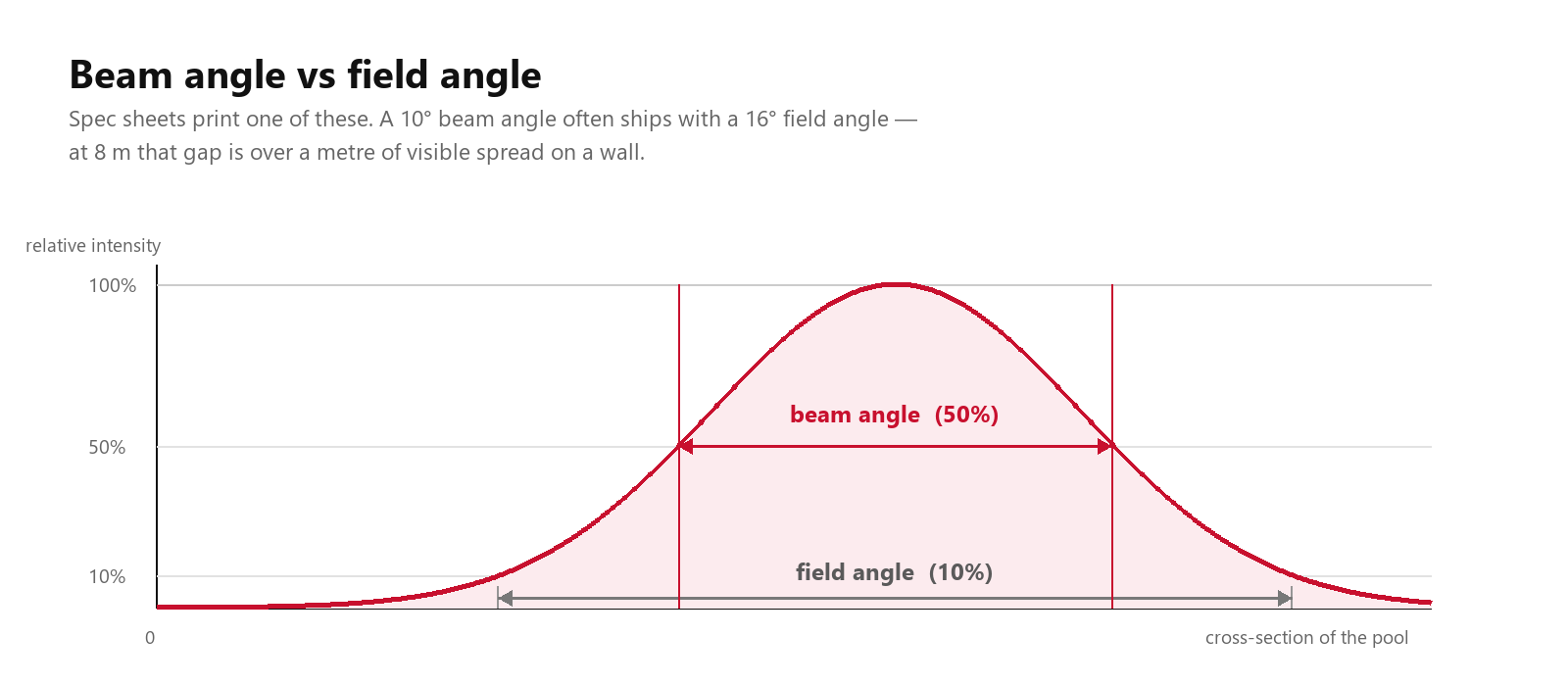
- Beam angle is measured across the width where intensity is still at 50% of peak.
- Field angle is measured across the width where intensity has fallen to 10%.
A fixture quoted at 10° beam angle might carry a 16° field angle. The beam figure describes the hot core; the field figure describes where the light has actually stopped being visible on a wall. At 8 m, that six-degree gap is more than a metre of apparent spread — enough to be the difference between "tight and expensive-looking" and "smeared across the backdrop".
Practical bands, and what they read as:
| Beam angle | What the audience sees | Typical use |
|---|---|---|
| 2°–4° | A hard column, defined in air | Clubs, arena shafts, long throws |
| 5°–10° | A bright pool with a crisp edge | Gobo projection, key light at distance |
| 10°–25° | A shaped pool, edge still legible | Theatre, corporate, most gobo work |
| 25°–45° | Soft coverage with a visible core | Front light, small stages |
| 45°–60°+ | Even field, no visible edge | Wall wash, floor wash, colour beds |
Two fixtures can share a beam angle and behave nothing alike, because the second variable does the rest of the work.
2.2 Edge hardness
Edge hardness is how quickly the light falls off at the rim of the pool. It is the single most visible quality difference between fixture classes, and it is almost never written on a datasheet.
- Hard edge comes from well-corrected imaging optics: a large aperture, a lens group that actually images, and no diffusion in the path. The rim is a crisp line.
- Soft edge comes from diffusion, a frosted front lens, or a wash lens array. The rim is a gradient of 15–30 cm at close range and much more at distance.
Neither is better. A hard edge shows every imperfection in the surface it lands on, and every fixture you can see. In a club where the beams are the show, that is exactly what you want. In a conference room with a scalloped wall behind the speaker and a camera on the front row, it is a problem you will spend the load-in trying to fix.
This is why wash fixtures exist as a category and not as "spots turned up wide". A spot zoomed to 50° still has an imaging lens in the path, and it will still leave a discernible rim and a hot centre.
2.3 Whether the light can be shaped
The third variable is binary: does the fixture have an imaging system, or does it not?
- Beam: no focusable imaging. Fixed gobo wheels are common, but they are pattern inserts into a column, not a projected image you can focus.
- Spot: a focusable lens group plus gobo wheels. This is what lets you throw a logo, a breakup, a window gobo or a leaf pattern and have it land sharp.
- Wash: no gobo, no focus, by design. Adding a gobo to a wash defeats the purpose — the pattern gets diffused into mush within two metres.
On top of that, some spots add framing shutters (cutting). That is a different capability again: the ability to physically trim the beam into a rectangle so it stops at the edge of a screen, a portal or a piece of architecture. If a room has a video wall, shutters are usually the reason a spot gets specified over a wash.
3. Beam: Why 2° Still Reads at 30 Metres
A beam fixture's job is visibility, not illumination. The audience is not looking at the surface the light lands on — they are looking at the light itself, hanging in haze. That changes the engineering completely.
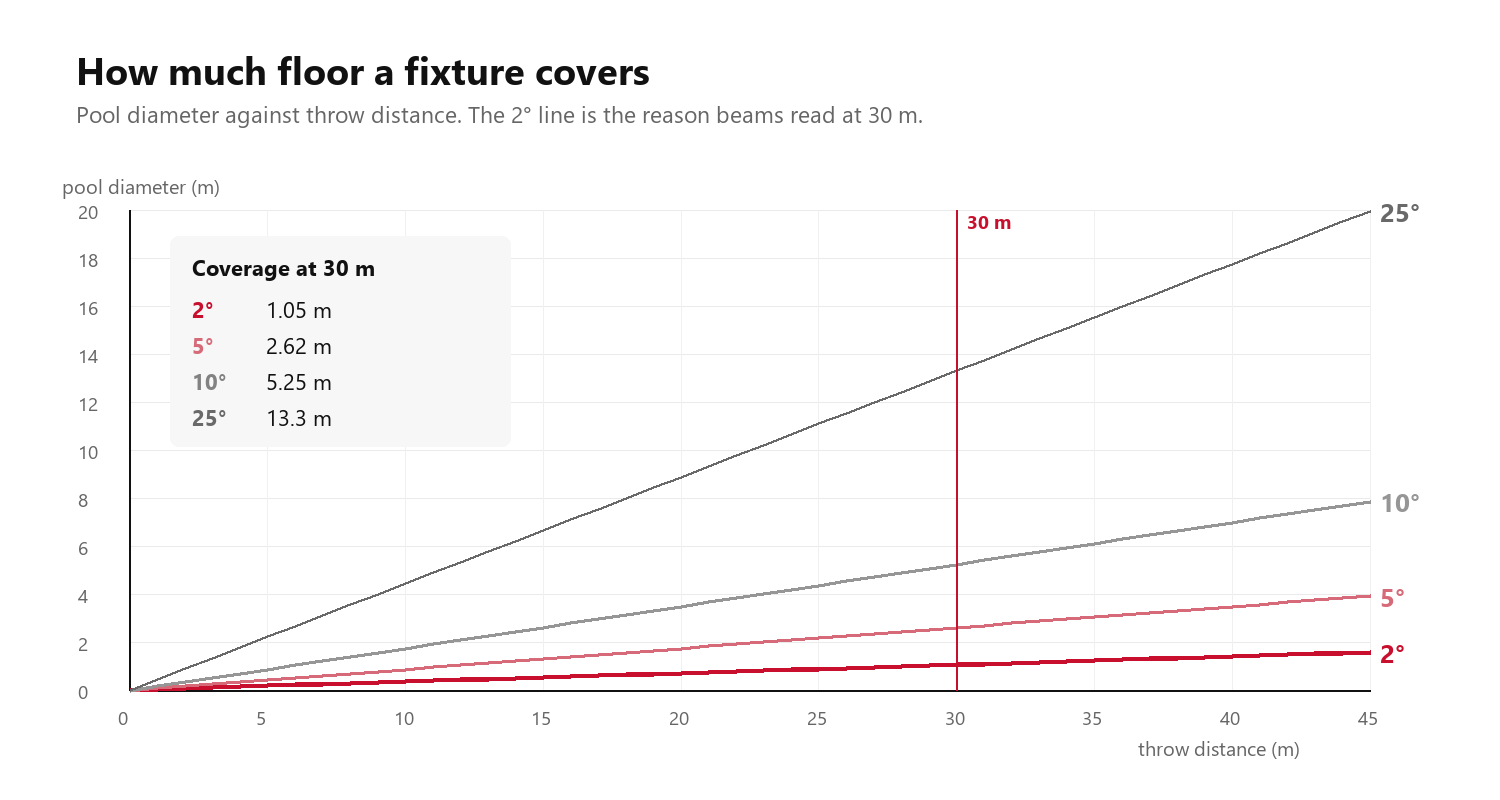
Two degrees sounds like a trivial number until you convert it into a diameter:
Cone diameter ≈ 2 × distance × tan(angle ÷ 2)
- At 10 m: 0.35 m
- At 20 m: 0.70 m
- At 30 m: 1.05 m
- At 40 m: 1.40 m
A one-metre shaft at thirty metres is visually razor-thin. That is the entire effect. Meanwhile a 10° spot at the same throw covers 5.25 m — five times the width, and roughly 25 times the area.
That area ratio is the number worth carrying into a quote meeting. Two fixtures of the same wattage do not have the same reach, because reach is set by how tightly the energy is packed. Concentrating the same output into 1/25th of the area is worth 25× the illuminance at the point where it matters. It is why a 300 W beam cuts through haze at 30 m while a 300 W wash is barely visible at the same distance.
Why aperture matters more on a beam than anywhere else
Narrow angles are hard optics. To collimate light into 2°, the lens has to be large relative to the source, or the focal length has to be long — and a long focal length in a moving head means a physically long fixture that will not balance on a 4 m truss.
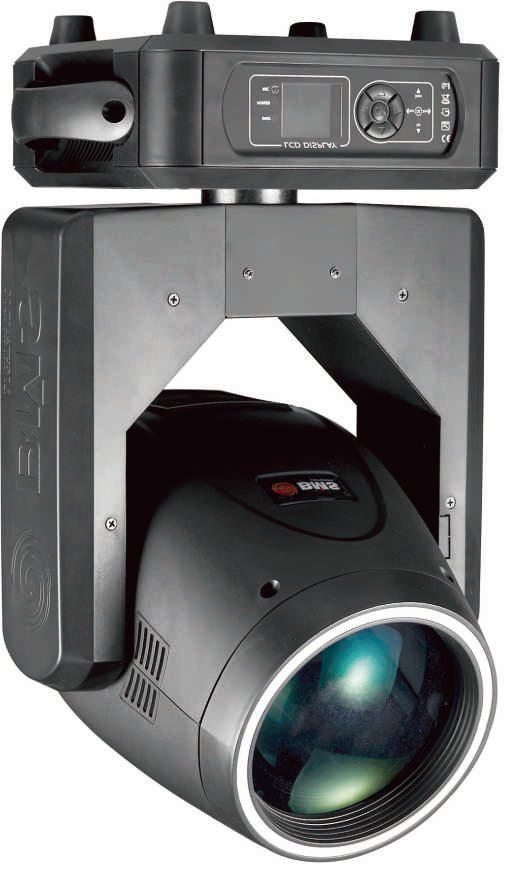
That is why beam fixtures are built around a big front aperture. Our own BMS-BEAM300S runs a 145 mm output aperture to hold a 2° beam from a 300 W discharge lamp in a body 515 mm long and 13 kg. Shrink the aperture and you either lose the tight angle or lose the light that makes the angle worth having.
Where a beam is the wrong tool
- Truss under 6 m to the floor. At 5 m, a 2° beam is a 17 cm dot. There is nothing to see.
- Anything that needs to light a person. A beam on a performer's face reads as a hard white spot with no falloff and no control.
- Any moment when the haze is off. The moment the hazer stops, a beam becomes a small bright circle on the floor. This is the single most common complaint from venue owners who bought an all-beam rig.
4. Spot: The Fixture You Can Give Instructions To
A spot is the only one of the three that can be told what to do. Focus it, size it, put a pattern in it, rotate the pattern, iris it down, trim it with shutters. That flexibility is why it carries the widest price range in any catalogue.
Gobo quality is the real dividing line
Two spots with the same wattage can differ by a factor of three in perceived quality, and it usually comes down to the gobo wheels.
- Metal gobos are etched stainless steel. Cheap, heat-tolerant, opaque, and limited in fine detail — thin bridges between shapes tend to be coarse.
- Glass gobos are photographic or dichroic. Much finer detail, colour capability, and a different look entirely — but they cost more, they are fragile, and they need the optical train to be clean or they look muddy.
A single fixed wheel is the budget arrangement. The step up is fixed plus rotating: one wheel for fast pattern changes and one with rotation and indexing for detail work. Our BMS-BSW500 carries a fixed wheel of 11 patterns plus open, and a rotating glass wheel of 7 plus open — enough to cover both the "change it every eight bars" job and the "project the client's logo, sharp, at 12 m" job.
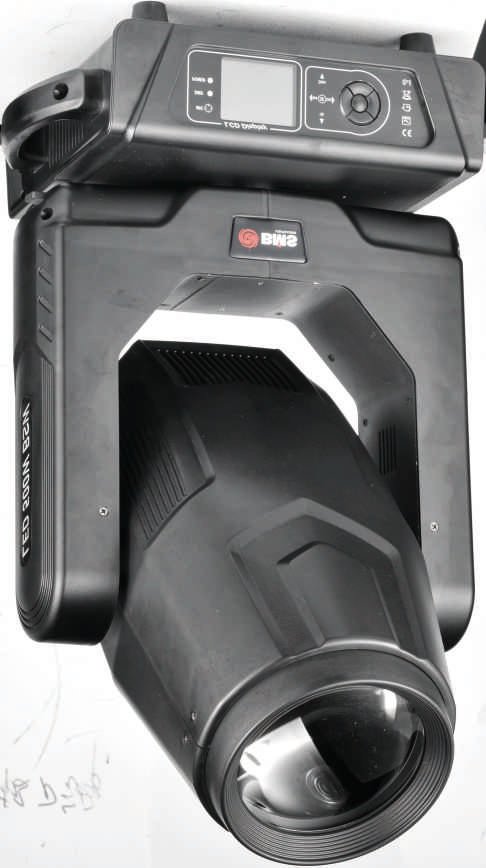
Hard-edge versus soft-edge spots
Not every spot is a profile. Two sub-types get conflated constantly:
- Hard-edge spot — imaging optics, crisp rim, no diffusion. Best for gobos at distance and for anything that needs to look precise.
- Soft-edge spot / fresnel-type — a diffused or fresnel front. The pool has a soft rim and an even core. Better for people, better for camera, more forgiving of a surface that is not perfectly flat.
If a venue has both a stage and a video camera, the soft-edge spot will be on the talent and the hard-edge will be on the set. That is not a compromise, it is the correct division of labour.
When shutters are non-negotiable
Framing shutters cut the beam into a shape. Specify them when:
- The light has to stop at the edge of a projection screen or LED wall.
- The room has architectural features — columns, portals, coffers — that must not be lit.
- The truss is at an oblique angle to the stage and a round pool would spill onto the floor in front of it.
Without shutters, the fix is a wider fixture position, a barn door, or a lot of black wrap. All three cost more load-in time than the shutters cost at purchase.
5. Wash: Coverage Is a Different Job
The mistake with wash fixtures is judging them by brightness. Bright is easy. Even is hard.
A wash is doing well when an audience cannot tell where one fixture ends and the next begins. That means:
- Uniformity across the field — a wash with a hot centre and a dim rim will show as a row of bright dots on a wall, no matter how wide the zoom is.
- Overlap — washes are designed to be overlapped by roughly 30–40%. A row of 25° fixtures 3 m apart at 5 m trim height will not blend, and no amount of focus will fix it.
- Soft boundaries — the field edge has to fall off gradually, which is why diffusion is a feature and not a weakness.
The arithmetic catches people out. At 5 m trim height, a 25° wash covers 2.2 m. A 12 m wide stage needs six of them just to reach the edges with no overlap at all — and eight or nine once you overlap properly. That is why wash counts in a plot are always higher than people expect, and why "we'll just widen the spots" never produces an even field.
Bee-eye and pixel washes
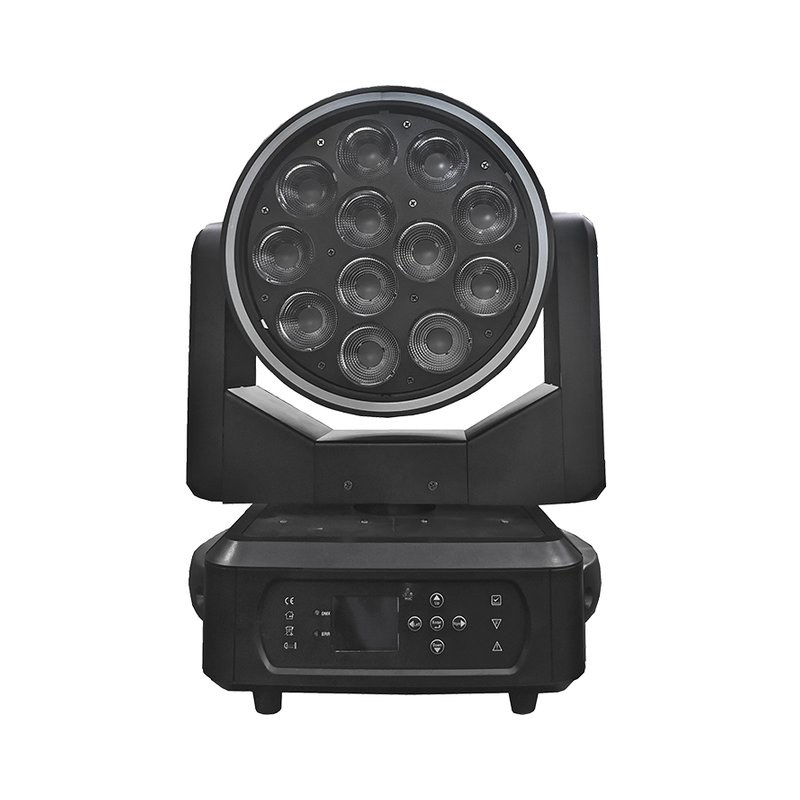
Multi-lens wash fixtures — sometimes called bee-eye — put a grid of small lenses behind one large front face. They produce two things at once: a wide, reasonably even wash, and a visible matrix of individual beams when you look into the fixture. That matrix can be rotated, zoomed and chased, which is why they have become a fixture of club and banquet design rather than a niche product.
Our BMS-1925BEE is that type. It is not a substitute for a proper wash in a room that needs an even field — it is a substitute for two fixtures, a wash and an effect, in a room that wants movement.
6. The Comparison Table
This is the table to bring into the quote meeting. Every row is something a client will ask about, and every row has a defensible answer.
| Beam | Spot | Wash | |
|---|---|---|---|
| Beam angle | 2°–6°, usually fixed | 10°–45°, usually zoomable | 25°–60°, zoomable |
| Edge | Hardest | Hard to soft (frost) | Soft by design |
| Gobo / imaging | Fixed patterns, no focus | Fixed + rotating, focusable | None |
| Framing shutters | No | On some models | No |
| Primary job | Visible shaft in haze | Shaped pool, projected image | Even colour field |
| Works without haze | Poorly | Well | Well |
| Useful throw | 10 m–40 m+ | 4 m–20 m | 2 m–12 m |
| Coverage per fixture (at 10 m) | ~0.35 m | 1.7 m–8 m | 4.7 m–11 m |
| Typical engine | 295 W–420 W discharge | 200 W–700 W LED or discharge | 12×25 W to 19×15 W LED |
| Typical weight | 10–14 kg | 13–23 kg | 12–22 kg |
| Count in a typical plot | Low | Medium | High |
| Fails visibly when | Haze is off | Focus is soft | Fixtures are too far apart |
Two rows in that table deserve a second look. "Works without haze — poorly" is not a knock on beam fixtures; it is a design constraint that has to be planned for, usually by pairing every beam position with a wash. And "fails visibly when fixtures are too far apart" is the reason wash counts escalate so quickly once a room gets wide.
7. The Three-in-One Question
A BSW — beam, spot, wash — puts all three modes in one housing, usually by combining a wide zoom range with gobo wheels and CMY colour mixing.
The pitch is obvious: one fixture position does the work of three, so you buy fewer units, run fewer cables, and carry one spare instead of three. For a rental house or a multi-purpose room that has to be a conference centre on Tuesday and a wedding venue on Saturday, that is a genuinely strong argument.
It is also a set of compromises, and a supplier who will not name them is not giving you a specification, they are giving you a brochure.
Compromise 1 — the 2° end is not a real 2°. A zoom that reaches 5° is not the same as a fixed 2° optic. More elements in the light path means more loss, and a zoom group cannot hold the same collimation at the narrow end. If the design depends on a razor-thin shaft at 30 m, a dedicated beam will beat a three-in-one every time.
Compromise 2 — the wide end is not a wash. At 55° a single-lens zoom produces a broad pool with a soft-ish rim, but it will not match the evenness of a purpose-built wash with a diffusion face and a wider field. Our BMS-BSW500 zooms 5°–55° — which is a genuinely useful range, and still not the same thing as a 19×15 W wash bar.
Compromise 3 — weight and price per position. A 500 W three-in-one in the same class weighs around 22 kg. Three dedicated fixtures weigh more in total but each one is lighter, cheaper to replace individually, and can be rigged on separate positions where the design actually needs them.
A decision rule that holds up in practice:
- Permanent install, fixed truss, known show format → dedicated beam, spot and wash. You will get better optics per euro and easier service.
- Touring, rental, or a room with no fixed format → three-in-one. The flexibility is worth the optical compromise.
- Truss under 8 m and a tight budget → three-in-one is often the right answer, because at short throws the difference between 2° and 5° is 17 cm versus 44 cm — both read as "a beam".
- A design that is 80% beam shafts → buy beams. A three-in-one used at 5° all night is an expensive way to buy a compromise.
8. Choosing by Room
Angle and type only become a decision once you know the trim height and the throw. The same fixture is excellent in one room and useless in the next.
| Room | Trim height | Dominant need | Practical rig |
|---|---|---|---|
| Bar / KTV | 3.5–5 m | Movement, shafts in haze, colour changes | Beam 2°–5° on the back truss, wash on the floor and walls, 1 spot for the stage |
| Banquet / wedding | 6–9 m | Colour washing, gobo monograms, camera-friendly skin | Wash on the perimeter, hard-edge spot for gobos, a few beams for entrances |
| School auditorium | 8–12 m | Even front light, quiet operation, low maintenance | Soft-edge spots on the front truss, wash for colour, LED throughout |
| Outdoor / cultural tourism | 12 m+ | Long throw, weather protection, visible at distance | IP-rated beam 2°–4°, high-output spots, no diffusion |
A few observations from those rows that do not fit neatly in a table:
Bars live or die on haze. Almost every "the beams look weak" complaint from a bar is a hazer problem, not a fixture problem. If the venue will not run haze, the money is better spent on wash and pixel effects than on more beam.
Banquet rooms are the hardest brief, because the same rig has to look good to a phone camera at 2 m and to a guest at 15 m. That is where CMY plus CTO earns its price — being able to dial colour temperature to match the room's tungsten and the camera's white balance is worth more than another 100 W of output.
Auditoriums need quiet. A discharge beam at 2° is the wrong fixture not because of the light but because of the fan. LED fixtures with a low-noise mode are the specification, and the maintenance argument (20,000 h versus 1,000–2,000 h lamp life) usually closes the budget conversation on its own.
Outdoor work is a different discipline. Long throws, IP-rated housings, and no diffusion — a soft edge at 30 m outdoors just disappears into ambient light. This is beam and hard-edge spot territory, and it is the one place where the 2° optic is not a stylistic choice but a requirement.
9. The Most Expensive Mistake: An All-Beam Rig
The most common rigging error we see in a new venue is a truss loaded entirely with beam fixtures. It happens for a good reason: the demo video looks spectacular, the beams are the cheapest way to fill air, and the client approved the plot from a photograph taken with a hazer running.
Then the room opens, the hazer runs out, and the venue owner is standing in a space lit by fourteen small white circles on the floor.
The failure is not subtle and it is not fixable with settings. What was missing is a base layer — wash fixtures giving the room colour and a floor, so the beams have something to cut through. Beams are the top layer of a design, not the whole design.
A ratio that survives contact with real venues:
- Club / bar: roughly 2 beam : 1 wash : 1 spot. The beams carry the show, the wash carries the room, the spot carries the artist.
- Banquet / multi-purpose: 1 beam : 3 wash : 1 spot. Colour and monograms matter more than shafts, because the room has to work for a ceremony, a dinner and a dance floor in the same evening.
- Auditorium: mostly wash and soft spot, with beams only if there is a haze-capable show programme.
Exact counts depend on the plot, but the direction never changes: if the design has no wash, it has no room.
10. Five Questions Before You Order
Answer these before the purchase order goes out. They take ten minutes and they prevent most of the returns I have seen.
- What is the trim height, and what is the longest throw? Both numbers, not one. A 2° beam at 6 m and at 30 m are different products in practice.
- Will the venue actually run haze? If the answer is "probably not", cut the beam count and move the budget to wash.
- Does anything need to land as an image? Logos, breakups, windows, textures. If yes, you need a focusable gobo spot, and you need to know whether the gobo is metal or glass.
- Will there be a camera? If so, CTO and soft-edge optics stop being optional. Tungsten-matched white and an even field matter more on screen than on site.
- Who services it, and how do they reach it? A 22 kg three-in-one on a 9 m truss is a two-person job with a lift. Three 13 kg dedicated fixtures are a one-person job with a ladder. Maintenance access is a specification, not an afterthought.
Get those five answered and the beam / spot / wash split tends to resolve itself. The remaining decisions — brand, colour system, zoom range — are the easy ones, because by then you know what the room actually needs to do.
Working out a fixture mix for a specific room? Send us the trim height, the room dimensions and what the space has to do on a normal night — we will come back with a beam / spot / wash split, a fixture count and the models that fit the budget, rather than a catalogue.