Every moving head manual says the same thing: clean the fixture every three months. That number was written for a clean room, a short week and no haze. A club running five nights a week through glycol fog is exposed to roughly ten times that environment — and the failure it produces does not look like dirt. It looks like a fixture that strikes, runs for twenty minutes, and drops out. This is how to work out the interval your rig actually needs, and what to do inside it.
1. The Instruction That Fails at 3 a.m.
A bar installs eighteen beam fixtures. The manual says clean quarterly. Everyone agrees, nobody diarises it, and the rig opens in October.
By the middle of November the front lenses have a visible film — not dust, a faint iridescent haze you only catch at an angle. By early December one fixture on the back truss strikes at power-up, runs for eighteen minutes, then goes dark and relights itself. By New Year it does it every night.
Nothing is defective. The lamp housing is choked with the same film that is on the lens, the thermal path is blocked, and the fixture is protecting itself the way it was designed to. The manual was not wrong. It was describing a different room.
The useful question is not "what does the manual say". It is: what is this fixture actually being exposed to, and how many hours has it run?
2. Four Variables Set the Interval, Not the Calendar
2.1 Duty hours, not weeks
Two fixtures on the same site can both receive the instruction "clean quarterly" while one has run 50 hours and the other has run 500. Weekly calendar language hides a tenfold difference in exposure.
This is why every interval in this article is expressed in operating hours first, with a calendar equivalent second. Hours are the thing that accumulates film, heat cycles and fan wear. Weeks are just how we remember to check.
2.2 Haze fluid — and why it gets inside the fixture
Haze and fog fluid is a glycol or glycerine mixture. It does not vanish after the beam fades; it settles on every cool surface in the room, including the front lens of every fixture in the air.
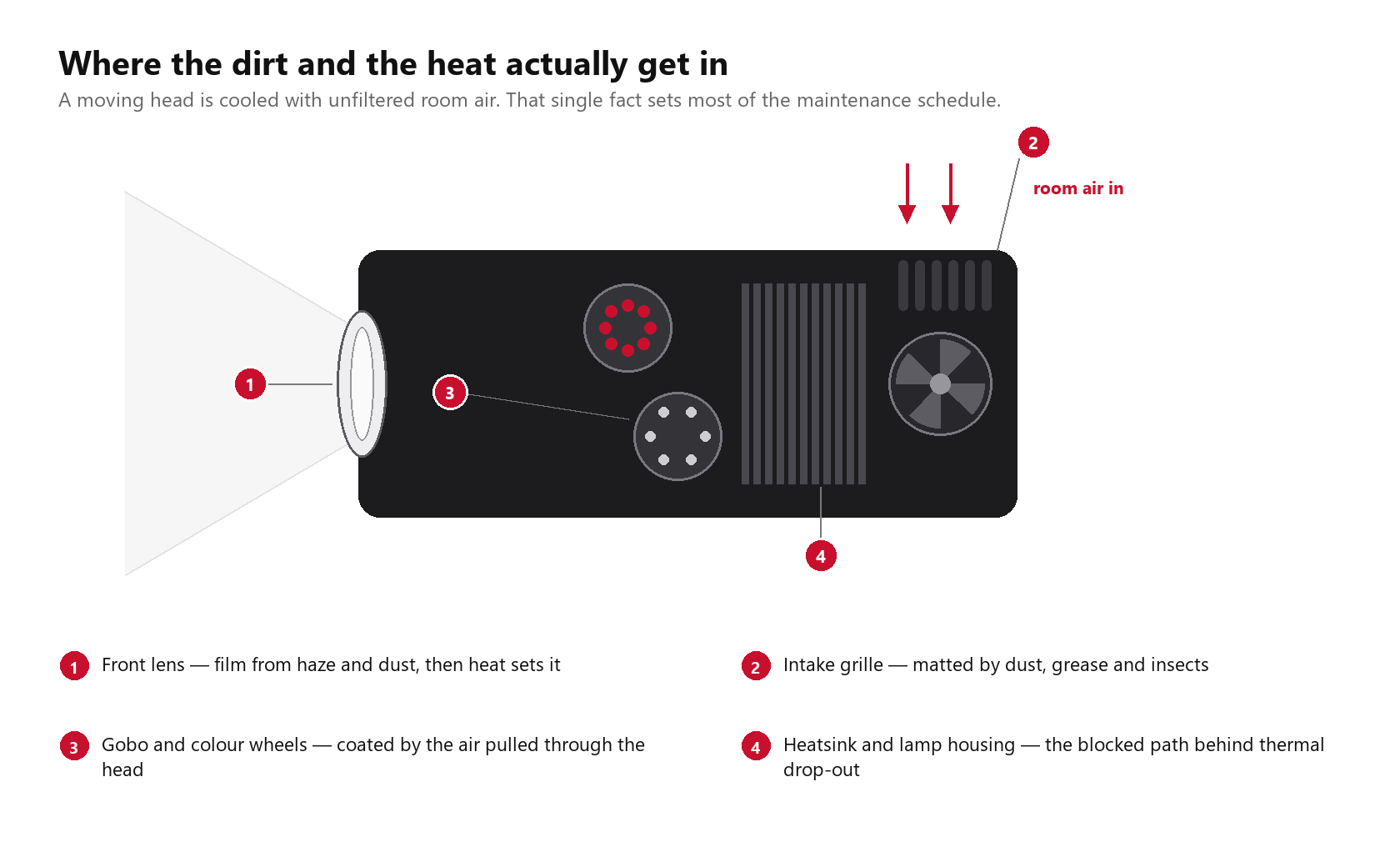
The part most people miss is that it also gets inside. A moving head is cooled by pulling unfiltered room air through the head and across the lamp housing or LED heatsink. Whatever is floating in the room goes through that path — and the gobo wheel, colour wheel and inner lens surfaces sit directly in it. That is how a fixture that has never been opened ends up with a coated pattern wheel.
Haze residue is also not dust. It is a deposit that softens with heat and then sets. Left long enough it bakes onto coated optics, and at that point no amount of cleaning restores the original transmission.
2.3 Particulate load
Not all dirt is equal:
- Urban dust is abrasive and dry. It blocks airflow and scatters light.
- Kitchen grease, in banquet halls and any venue with a nearby extractor, is sticky. It captures dust and turns a cleanable film into a bonded layer.
- Coastal salt is hygroscopic — it pulls moisture onto metal parts and accelerates corrosion on connectors and board edges.
- Construction and road dust is fine and highly mobile; it reaches heatsink fins that a brush cannot.
- Insects outdoors block grilles and nests in vents, which is a blocked cooling path with legs.
2.4 Thermal stress
Heat multiplies every other failure mode. A fixture packed against nine others under a low truss, or sitting in an enclosed ceiling void at 38 °C ambient, runs its lamp envelope, driver electrolytics and lubricant harder than the same fixture in free air. The same dirt that is harmless in a cool position will cause thermal shutdown in a hot one.
2.5 The arithmetic
A working starting point for the optical clean interval:
Interval (hours) = 500 × haze × particulates × thermal, with a floor of 100 hours
| Condition | Factor |
|---|---|
| Haze: none | 1.00 |
| Haze: occasional, 1–2 nights a week | 0.85 |
| Haze: 4+ nights a week | 0.60 |
| Haze: continuous (theatre fog, heavy club) | 0.50 |
| Particulates: clean, filtered air | 1.00 |
| Particulates: urban dust | 0.85 |
| Particulates: kitchen grease | 0.70 |
| Particulates: construction or road dust | 0.65 |
| Particulates: coastal salt | 0.60 |
| Thermal: free air, spaced positions | 1.00 |
| Thermal: tight cluster under a low truss | 0.90 |
| Thermal: enclosed void, ambient above 35 °C | 0.85 |
Three worked examples:
- Theatre, 15 h/week, no haze, clean air, spaced positions. 500 × 1.00 = 500 h, which is 33 weeks. Twice a year is correct, and the manual's quarterly advice is conservative but harmless.
- Club, 35 h/week, haze five nights, urban dust, clustered truss. 500 × 0.60 × 0.85 × 0.90 = 229 h, which is 6.5 weeks. Quarterly is roughly twice too long — and that is exactly the rig in section 1.
- Coastal outdoor bar, 40 h/week, no haze, salt air. 500 × 0.60 = 300 h, about 7.5 weeks for optics — but its seals need attention on a calendar clock, not an hours clock, because rubber ages by UV and ozone whether the fixture runs or not.
That last point matters: not every task on a fixture runs on the same clock. Optics accumulate film by hours. Gaskets, belts and lubricants age by time and heat cycles. Hardware loosens by transport. One interval for everything is how maintenance plans die.
3. Classify the Room First
Before the table, decide which of three environments each fixture is actually in. Positions on the same truss can be in different tiers — the two fixtures above a kitchen pass-through are not in the same environment as the four in the ceiling void.
| Tier | Typical venue | Duty | Haze | Optical clean interval |
|---|---|---|---|---|
| A — Controlled | Theatre, studio, corporate AV, school auditorium | under 20 h/week | none or occasional | 400–500 h |
| B — Active | Nightclub, bar, banquet hall, live house | 25–40 h/week | 4+ nights/week | 220–320 h |
| C — Hostile | Festival and touring, dusty industrial, kitchen-adjacent, construction sites | any | any | 100–200 h |
Tier A is where the manual was written. Tier B is where most of the world's fixtures actually live. Tier C is where the fixtures that "keep failing" come from.
4. The Interval Table
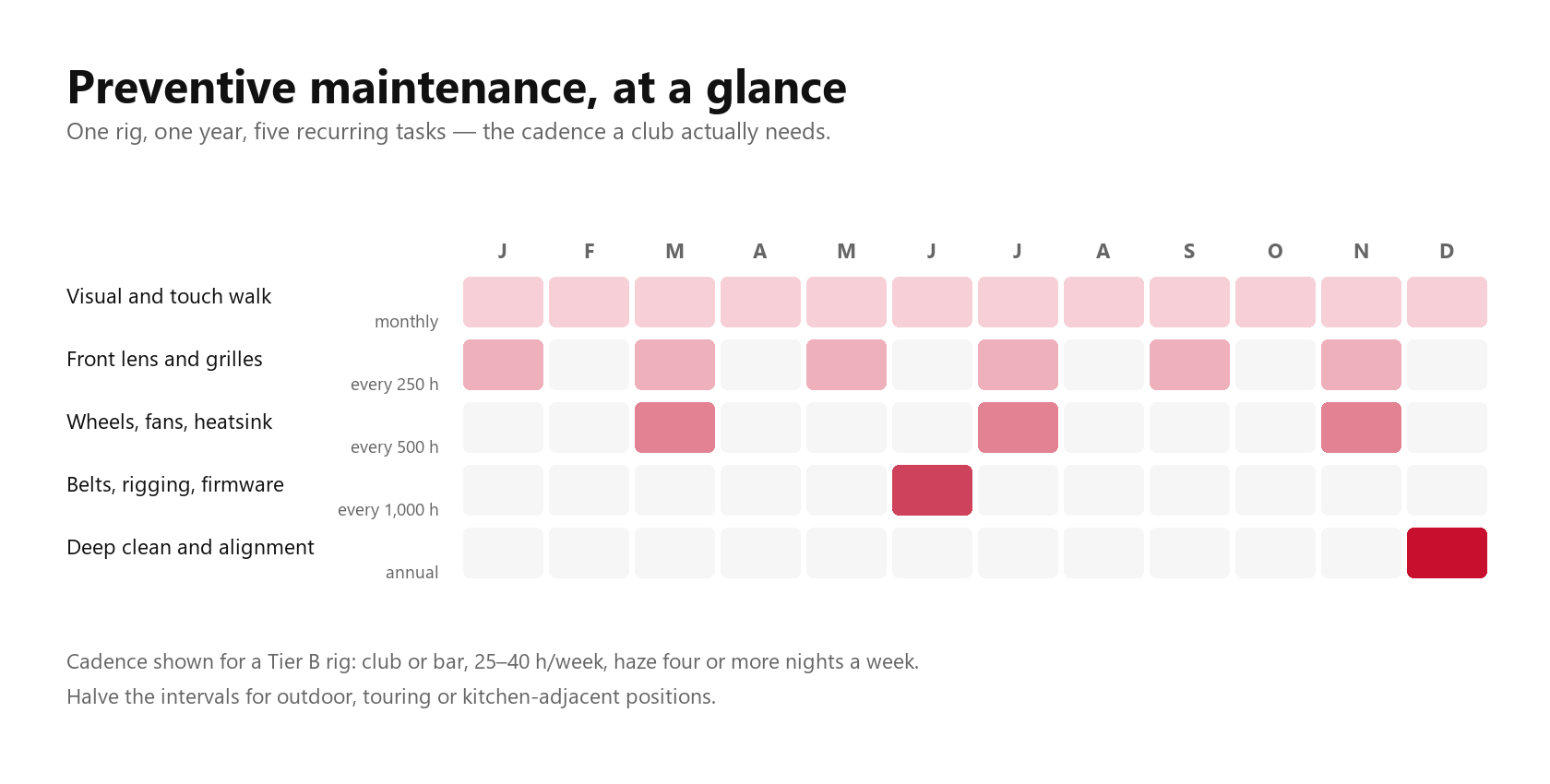
This is the table to put on the wall of the service room. Hours are operating hours per fixture; where a task is driven by handling or ageing rather than running time, it is given in calendar terms because that is what actually governs it.
| Task | Tier A | Tier B | Tier C |
|---|---|---|---|
| Visual and touch walk (fans, play in pan/tilt, listen) | monthly | every 2 weeks | weekly |
| Front lens and output window — wipe | 500 h | 250 h | 120 h |
| Intake and exhaust grilles — clear | 250 h | 120 h | 60 h |
| Fan blades and heatsink fins — clean | 500 h | 250 h | 120 h |
| Gobo and colour wheels — inspect and clean | 1000 h | 500 h | 250 h |
| Belt tension, drive and lubrication | 2000 h | 1000 h | 500 h |
| Connectors, cable and strain relief | monthly | monthly | every load-in |
| Rigging hardware and clamp torque | annual | 6 months | every load-in |
| Lamp hours audit (discharge fixtures) | monthly | monthly | weekly |
| IP seals, breather, desiccant (outdoor only) | n/a | n/a | quarterly, calendar |
| Firmware and DMX address audit | annual | annual | annual |
| Deep clean and optical alignment check | 2000 h | 1000 h | 500 h |
To read that in calendar terms, take the duty figure. At 30 hours a week:
- 250 h ≈ 8 weeks
- 500 h ≈ 4 months
- 1000 h ≈ 8 months
- 2000 h ≈ 15 months
If your rig runs 15 hours a week, double those periods. If it runs 48, halve them. The hours do not change; only the date does.
5. What Each Task Actually Catches
Maintenance schedules usually fail because the tasks read as housekeeping. They are not. Each line in that table is aimed at a specific failure chain, and the chain is what justifies the time.
| What you see | What is actually degraded | Task that catches it | If it is ignored |
|---|---|---|---|
| Strikes, runs 15–20 min, drops out, relights | Blocked airflow across the lamp housing or igniter | Grilles and heatsink | Lamp and igniter replacement |
| One fixture visibly dimmer than its neighbour | Film on the front lens or inner window | Front lens wipe | Baked coating, permanent transmission loss |
| Gobo edges soft, halo around the pattern | Dust on the wheel and on the imaging lens | Gobo wheel clean | Residue set on glass gobos, irreversible |
| Pan or tilt drifts, squeals, loses position | Belt tension, dried lubricant, motor load | Belt and drive check | Tooth skip, position errors mid-show |
| Display flickers or buttons misbehave after a load-in | Ribbon connector partially seated | Connector inspection | Intermittent faults that burn a service visit |
| Random resets in hot weather | Thermal derating or shutdown | Heatsink and fan clean | Power supply or driver failure |
| Water spots inside the lens, outdoor units | Perished gasket or saturated breather | Seal inspection | Corrosion on the mainboard |
The first row is the one that costs the most, and it is also the cheapest to prevent. A blocked lamp housing does not announce itself; it produces a fixture that behaves perfectly for eighteen minutes.
6. The Monthly Walk: Five Minutes per Fixture
This is the part that gets done when nothing else does, because it needs no disassembly, no ladder work and no schedule beyond a reminder. Five to seven minutes per fixture is realistic; a sixteen-fixture rig is one person for about ninety minutes.
- Power up and exercise the fixture. Full pan, full tilt, a gobo change, a colour change. Listen. A fan with a dry bearing or a piece of tape on a blade is audible before it is visible.
- Check the fans by hand, cold. With the fixture off and cool, reach the fan and spin it. It should coast freely and silently. Gritty or stiff means the bearing is going, and a slow fan is a lamp failure in waiting.
- Look into the aperture with a torch, at a low angle. Held straight on, a coated lens looks clean. Rake the light across the surface at 20° and the film appears immediately. This is the single most useful five seconds in the routine.
- Wipe the front lens. Dry microfibre first, in circles, to lift loose dust without grinding it. Only if a film remains, use 70% isopropyl alcohol on a lint-free cloth. Never acetone, never an abrasive, never sprayed directly at the fixture.
- Check the grilles. Hold a torch behind them, or vacuum with a brush nozzle. A matted grille is the beginning of section 5's first row.
- Check the cable, the connector and the clamp. Strain relief present and gripping, connector latched, clamp bolt tight, safety bond attached.
- Log the hours and note anything that changed. One line per fixture. The value of the log is not the record, it is that a change becomes visible.
Do not "blow out" a fixture with compressed air. It over-speeds fan bearings, drives dust deeper into the heatsink and optical chamber, and on outdoor units it can push moisture past a seal. Use a vacuum with a soft brush, or a low-pressure air duster held well back.
7. Two Clocks: Lamp Hours and Calendar
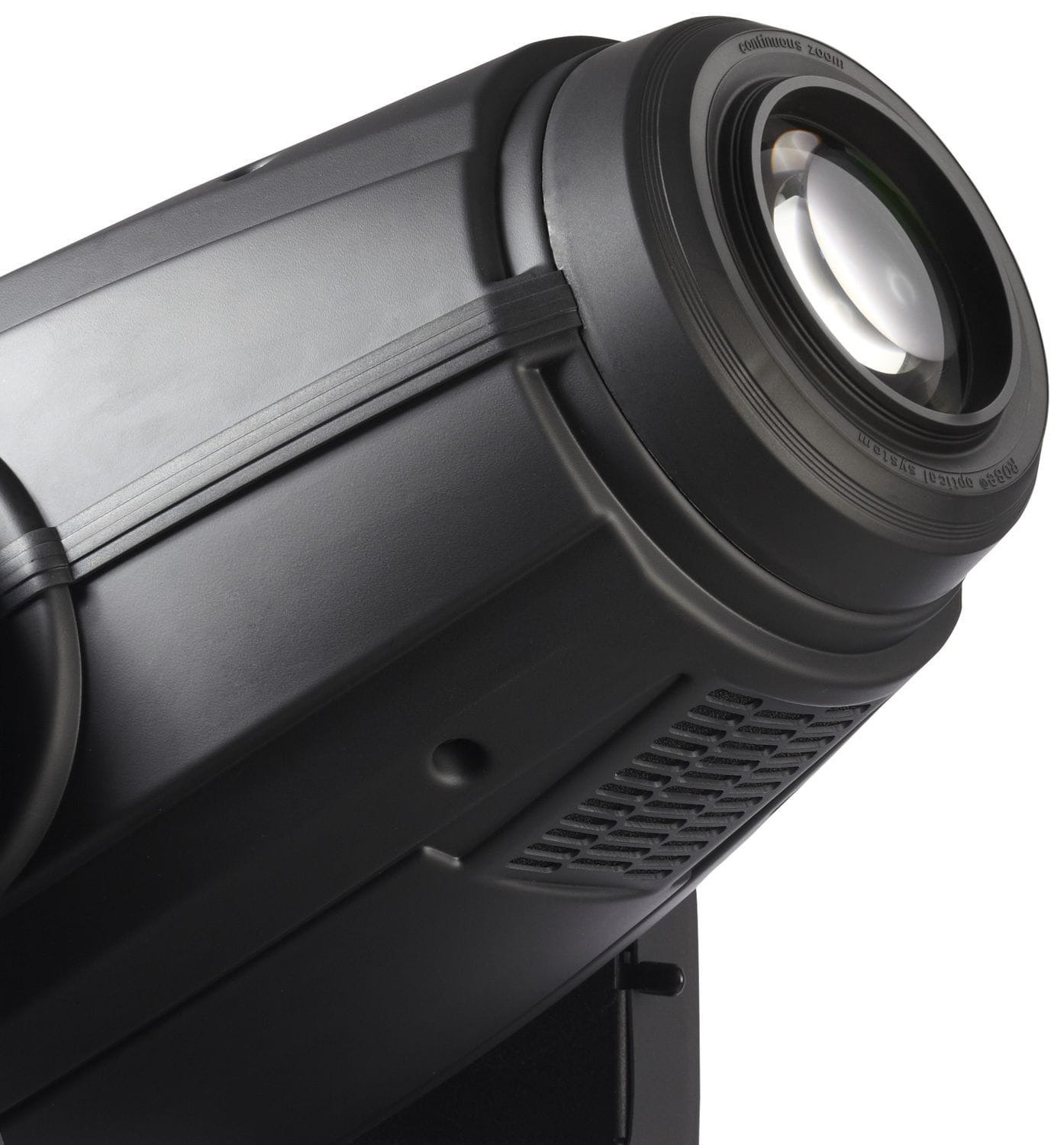
Discharge fixtures run on a consumable that has a hard life figure. Our BMS-BEAM300S carries a 300 W discharge lamp rated at 2000 hours. That number is not a service target, it is the point at which the lamp is finished — and it should never be reached in service.
Replace at roughly 80% of rated life. At 1600 hours, a discharge lamp has already lost a noticeable share of its output, its colour has drifted, and — the expensive part — its strike voltage has risen. A tired lamp loads the igniter every time it starts, and the igniter is a more expensive part than the lamp. Fixtures that "eat igniters" almost always have a lamp that was run to failure.
Run the numbers for your own rig:
- 5 h/night × 4 nights = 20 h/week → 1600 h in 80 weeks
- 8 h/night × 6 nights = 48 h/week → 1600 h in 33 weeks
Same lamp, same fixture, one is an annual job and one is a mid-year job. This is why "replace lamps annually" is only correct by accident.
LED Fixtures Are Not Maintenance-Free
An LED module rated at 20,000 hours or more is a statement about lumen maintenance — how long until output falls to a defined fraction of its original value. It is not a statement that the fixture has nothing left to wear out.
The LED is usually the last thing to fail. What actually takes an LED fixture off the truss is:
- Fan bearings. Same fans, same dust, and now they are the only thing standing between the module and thermal derating.
- Driver electrolytics, which age faster in a hot position.
- The front lens, which collects the same film as any other fixture and quietly costs you 10–15% of output before anyone notices.
- Thermal interface material, which dries and loses contact over years of heat cycling.
The LED failure mode is also the nastiest kind: it is gradual. A lamp that dies is obvious. A rig that has lost 20% of its output over three years looks completely normal, because every fixture lost it together. Compare against a new unit once a year, or measure — an inexpensive lux meter at a fixed distance will show it.
8. Outdoor Fixtures: Four Extra Items
Outdoor units add a set of tasks that have nothing to do with hours and everything to do with weather. These are calendar items.
- Gaskets. Inspect the door and lens seals quarterly. Look for compression set — a gasket that stays flat when the cover is opened has stopped sealing, even if it looks intact.
- Breathers and desiccant. A blocked breather turns a sealed fixture into a condensation chamber: warm air at night, cold metal before dawn, water inside by morning. Replace desiccant on schedule, not when you see fog behind the glass.
- Condensation management. Powering the fixture up before the ambient temperature swings, and leaving the driver energized in cold weather, does more for condensation than any coating.
- Cable jackets and glands. UV degrades jacket compound and gland seals. A cracked gland is an IP rating that no longer exists — see our IP65 vs IP66 guide for why the rating is a test condition, not a permanent property.
Add one more: never pressure-wash an outdoor fixture. An IP65 or IP66 rating is defined against jets at specified pressure and angle for a specified time — not against a 120-bar washer held at 200 mm. Washers find the one gland that was already marginal.
9. The Arithmetic of Skipping It
Here is the honest annual cost of doing this properly, per fixture, for a Tier B rig at 30 hours a week.
| Task | Minutes | Times per year | Annual minutes |
|---|---|---|---|
| Monthly walk | 6 | 12 | 72 |
| Front lens clean | 15 | 5 | 75 |
| Grille and fan clean | 20 | 3 | 60 |
| Gobo and colour wheel | 25 | 1 | 25 |
| Belt and rigging check | 20 | 1 | 20 |
| Deep clean and alignment | 60 | 1 | 60 |
| Total | 312 min ≈ 5.2 h |
A 24-fixture rig is therefore about 125 technician-hours a year — roughly three working weeks for one person, or one week for a three-person crew between projects. That is the entire cost of the programme, and it can be scheduled into quiet weeks.
Now price the alternative using your own numbers. One fixture out of service on a Saturday night costs you a replacement unit, an emergency call-out, the shipping, and — the part that does not appear on an invoice — the client's confidence. If a single lost fixture-night costs more than the annual maintenance on four fixtures, the schedule pays for itself before it has prevented anything.
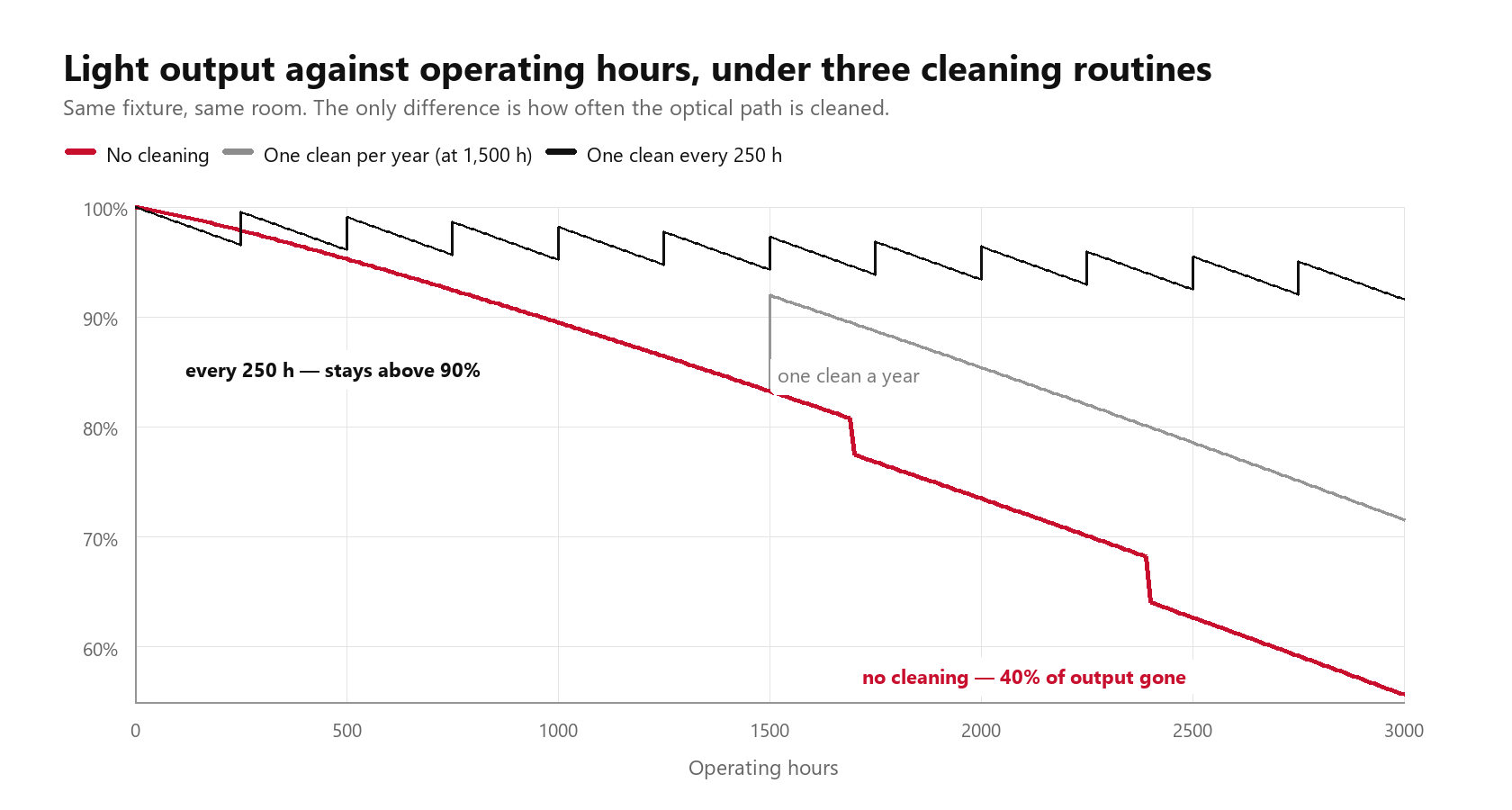
There is a second, quieter cost. Every hour a coated lens spends with film on it, under a hot lamp, moves a little of that film from "cleanable" to "permanent". Rigs that are cleaned regularly do not just fail less — they stay brighter for their whole service life, and that difference is measurable at the end of year three when one rig still looks like new and the other looks tired.
10. What to Keep on the Shelf
Spares should follow failure rate and lead time, not sentiment. For a rig of 24 fixtures:
- Two spare fixtures (roughly 8–10% of the rig) — one for a rental, one for a permanent install is a good rule of thumb.
- Lamps, for discharge rigs: at 30 h/week you will consume close to one lamp per fixture per year. Hold six, order twice.
- Fans — two per ten fixtures. They are cheap, they fail predictably, and a fan swap is a ten-minute job.
- Belts, one set per ten fixtures, plus the tension gauge the service manual specifies.
- Ribbon cables and a display board — the two parts that most often fail from handling rather than wear.
- Connectors: DMX 5-pin, power in and out, and a handful of fuses of each rating in use.
- Gaskets and desiccant for outdoor units, one set per six units per year.
- A cleaning kit that lives with the rig: microfibre cloths, 70% IPA, lint-free swabs, soft brushes, a vacuum with a brush nozzle, and a small torch.
The torch deserves its own line. It is the tool that turns "looks fine" into "there is film on this lens", and it costs less than a fan.
11. The Record That Makes It Work
A schedule without a record is a wish. The record needs six fields and no software:
| Serial | Hours | Last optical clean | Last deep service | Next due | Note |
|---|---|---|---|---|---|
| BMS-300S-0142 | 1,180 | 2026-10-04 | 2026-06-18 | 2026-12-02 | Fan 2 slight bearing noise |
| BMS-300S-0143 | 1,180 | 2026-10-04 | 2026-06-18 | 2026-12-02 | — |
Two practical notes on filling it in:
- Get the hours from the fixture, not from memory. Most fixtures report operating hours over RDM, which means a console or an RDM tool can pull the whole rig's counters in a few minutes without climbing. Our RDM guide covers how the discovery works.
- The "note" column is the valuable one. A fixture that keeps appearing there — fan noise, a stiff pan, a lens that films faster than its neighbours — is telling you its position is wrong, not that it needs more cleaning. Move it, and the problem usually stops.
12. Five Signs the Interval Is Wrong
The intervals in this article are a starting point, not a law. Let your own records move them. These five observations mean the number needs to change:
- Film is visible at six weeks on a rig you clean quarterly. Halve the interval. The environment factor was underestimated.
- Grilles are matted at every inspection. Shorten the grille task specifically — this is cheap, and it protects the expensive lamp housing downstream.
- Two thermal faults in one season. Stop cleaning more and look at the position: ambient temperature, airflow, fixture spacing. Dirt is not the only cause of heat.
- One fixture loses gobo detail faster than the rest. It is sitting in the hot or dirty position. Relocate it rather than servicing it twice as often.
- Three consecutive services find nothing. The interval is too short. Spend the hours on the fixtures that are actually dirty, and stop treating the whole rig as one object.
The underlying rule is simple: maintenance intervals are measurements, not traditions. A rig that has been running for two years has enough history to tell you what its interval should be — provided somebody wrote it down.
Frequently Asked Questions
How often should moving head lights be cleaned?
For a club running haze four or more nights a week, the optical clean interval is typically 220–320 operating hours, which is every six to eight weeks at 35 hours a week. For a theatre or auditorium with no haze and under 20 hours a week, 400–500 hours — roughly twice a year — is realistic. The calendar date follows from the hours, not the other way round.
Can I clean a lens with alcohol?
70% isopropyl alcohol on a lint-free cloth is acceptable on most coated optics, applied to the cloth rather than the lens, after loose dust has been lifted with a dry microfibre. Acetone, abrasive pads and household glass cleaner should not go near a coated element. If a film does not lift with IPA, it has probably baked on, and the element needs replacement rather than more solvent.
Do LED moving heads need maintenance?
Yes, but not the same maintenance. There are no lamps to change, so the wear items become fans, drivers, thermal interface material and the front lens. LED fixtures also fail gradually rather than suddenly, which means output loss is invisible without a comparison — measure or compare against a new unit once a year.
What happens if I skip preventive maintenance?
The first symptom is usually a fixture that strikes, runs for fifteen to twenty minutes and then drops out — a blocked cooling path, not an electronics failure. Left long enough, the same dirt that caused it bakes onto coated optics and into the lamp housing, at which point cleaning no longer restores the fixture. Most of the faults in our discharge lamp troubleshooting guide have a maintenance cause behind them.
Planning maintenance for a specific rig? Send us the venue type, the weekly duty hours and whether the room runs haze — we will come back with the interval table for your fixtures, the spare parts list worth holding, and the models that match the positions you are servicing.