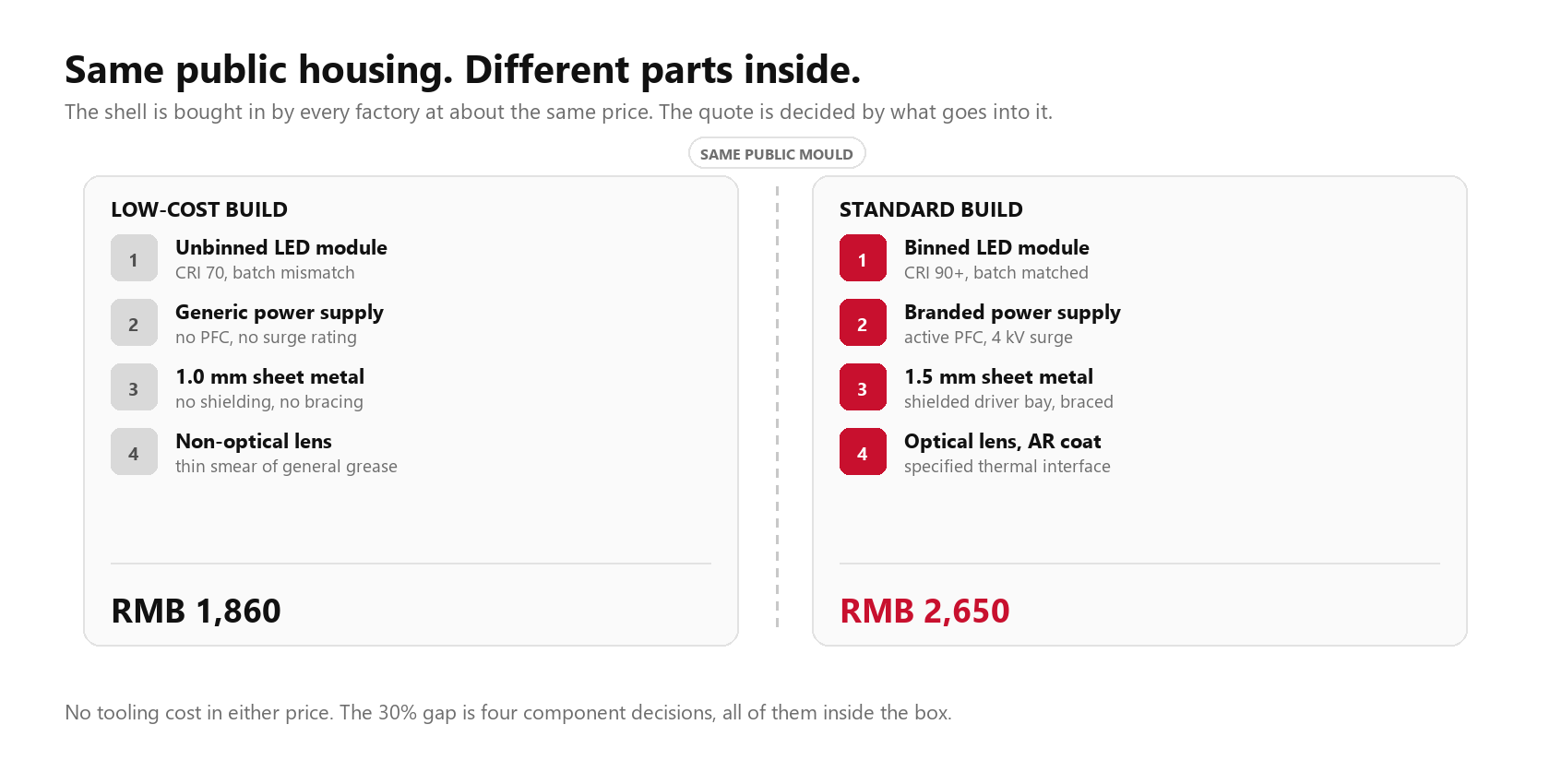
Two suppliers quote the same moving head. The photographs match — same public housing, same mounting points, same cable exits. One quote is 38% cheaper, and neither supplier is lying. A public housing carries no tooling cost into the unit price, which is exactly why dozens of factories can offer the same box; the price gap lives entirely in what gets bolted inside it. Light source, power supply, sheet metal, lens material, consumables. That is the whole argument, and almost none of it is visible in a catalogue.
1. Two Quotes, One Photograph
A distributor sends the same enquiry to five factories: 24 units of a 300 W LED beam, DMX/RDM, ceiling bracket. Five replies arrive. The two lowest sit within 4% of each other; the highest is 41% above the lowest.
The distributor does what most buyers do. He compares the photographs, sees the same housing, and assumes the same product. Then he asks the cheapest factory whether it can move on price.
The photographs really are the same. That is not a trick, and nobody is counterfeiting anything. In this segment of the industry a handful of housings are made from public moulds — the tooling was paid for long ago by whoever commissioned it, and the shell is now bought in like any other component, by anyone, in their own colour and with their own silkscreen. There is no tooling charge to amortise, no minimum order to justify, and no premium for the shape.
A public housing means the box costs roughly the same for every factory that buys it. When the most visible part of a product is the part with the least price variation, the price difference has to be somewhere else.
So the useful question is not "why is this one cheaper". It is: of the money I am about to spend, how much of it buys light, and how much of it buys a box that happens to look the same?
2. The Box Is the Part Everyone Gets Right
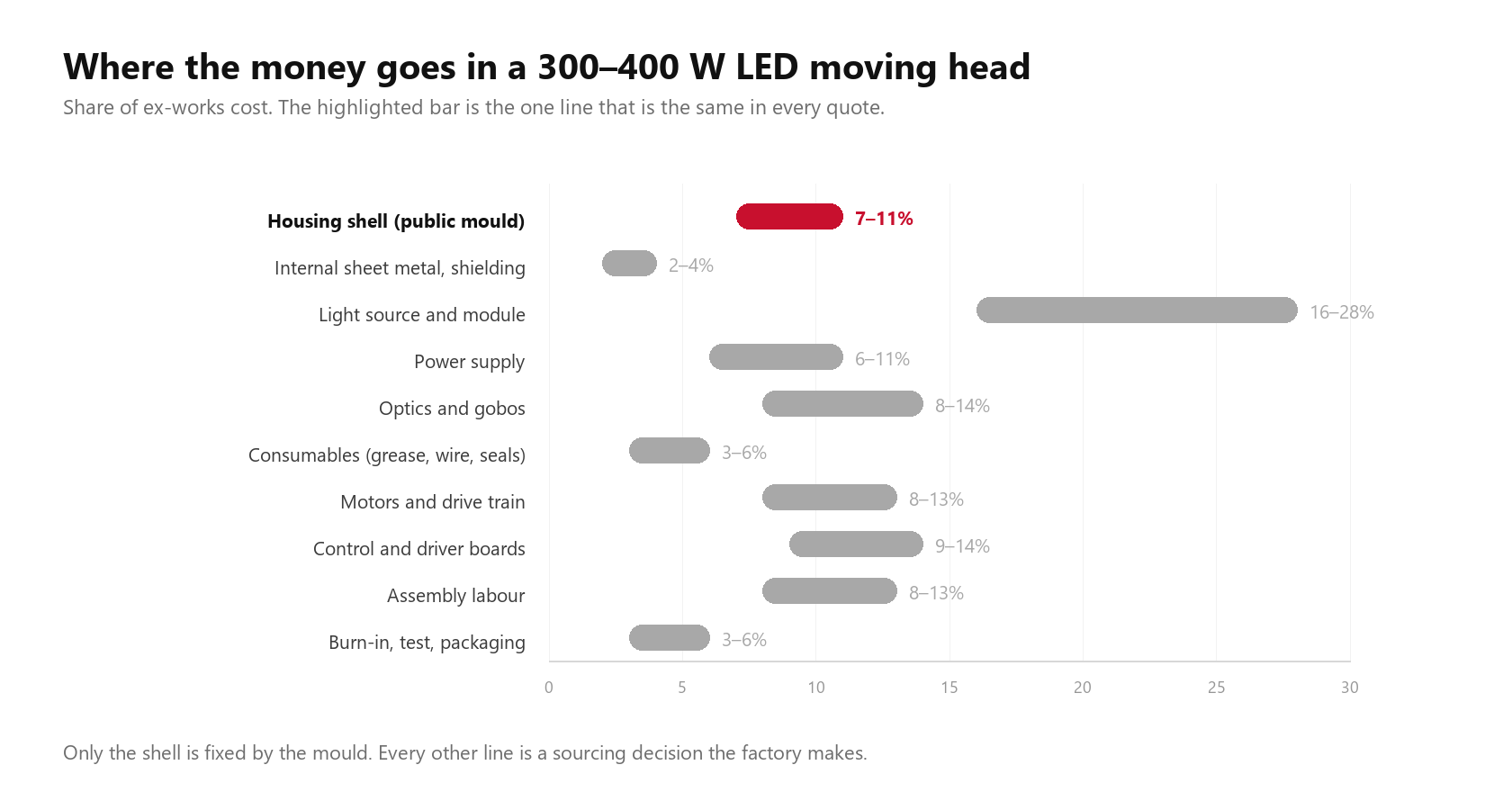
Start with what the housing actually contributes. On a 300–400 W LED moving head, the shell and the structural parts around it are typically 9–14% of ex-works cost — and because the mould is public, that percentage is largely the same for every factory quoting you. Sheet metal gauge, paint, the gasket channel, the mounting points: all fixed by the mould.
That is worth stating plainly, because it removes the most common misreading. The housing is not where quality is won or lost, and it is not where the price gap comes from. It is the part of the product that is already equal before anyone starts building.
| Cost element | Share of ex-works cost | Varies between factories? |
|---|---|---|
| Housing shell (public mould) | 7–11% | Almost none — same mould, same parts |
| Internal sheet metal, brackets, shielding | 2–4% | Widely — gauge, bracing, coating |
| Light source and module | 16–28% | Widely — brand, bin, CRI, consistency |
| Power supply | 6–11% | Widely — branded vs unbranded |
| Optics (lenses, reflectors, gobos) | 8–14% | Widely — material, coating, tolerance |
| Consumables (grease, wiring, connectors, seals) | 3–6% | Widely — and quietly |
| Motors and drive train | 8–13% | Widely |
| Control and driver boards | 9–14% | Widely |
| Assembly labour | 8–13% | Widely |
| Burn-in, test, packaging | 3–6% | Widely — hours are hours |
Two columns do not move: the shell, and almost nothing else. Everything else in that table is a decision the factory makes after the box arrives.
3. Inside the Same Box, Five Things Decide the Price
When the shell is a commodity, the quote is decided by five categories. Four of them are parts. In practice they are also the four places a cheaper factory takes money out, in roughly this order of size.
- Light source. Same stated wattage, different chip grade, binning, CRI and batch consistency.
- Power supply. Branded and protected, or generic and marginal.
- Sheet metal and structure. Gauge, bracing, shielding, grounding, coating — inside the box, invisible from outside.
- Lens material and consumables. Optical material, coating, and the unglamorous parts: thermal grease, wiring, connectors, seals, fasteners.
The fifth is not a part, and it is not a downgrade. It is a fixture whose measured power does not match the number printed on it — a 300 W label on a module that draws 196 W. It sits at the end of this list because it is the least discussed of the five, and it is the only one a purchase order can close outright.
Then two more that are not parts at all: how long the fixture is burned in before it ships, and whether anyone measured it — which is also the only practical defence against item five.
The rest of this article takes them one at a time, because "cheaper" is not a single decision. It is five or six separate decisions made in a factory you will never visit, and each of them has a different consequence two years later.
4. The Light Source: What "300 W LED" Hides
Two fixtures can both say 300 W and differ by 30% in what the module costs.
- Chip grade and binning. The same part number ships in brightness bins. Top-bin modules and lower-bin modules quote identically on a spec sheet and differ by 10–25% on cost — and by more than that on output at the same power.
- Colour consistency. Modules binned for tight chromaticity cost more. Unbinned modules produce the mismatch that becomes obvious the first time eight fixtures light the same wall in white.
- CRI. A CRI 90+ module and a CRI 70 module are different products at a similar price point, and the difference does not appear in a table that only lists wattage.
- Consistency between batches. A factory that builds in small batches from mixed stock delivers fixtures that are individually fine and collectively uneven. This one never shows up in a sample; it shows up in unit fourteen.
The consequence of a cheap source is not a fixture that fails. It is a fixture that is dimmer than it should be, drifts in colour against its neighbours, and loses output faster than the lumen-maintenance curve suggests — see our lamp versus LED comparison for how that curve is actually defined.
All of the above assumes the module is the one named in the datasheet, and that the fixture drives it as the datasheet implies. Neither is guaranteed. The next section is about the case where nothing has been downgraded and the fixture still is not the fixture that was ordered.
5. Rated Wattage Is Not a Measurement
Everything up to here assumes the fixture is what the datasheet says it is. That is not always a safe assumption — and this is the one place where a cheaper build is not selling a lower grade of part. It is selling a different number.
Three fixtures, all labelled 300 W:
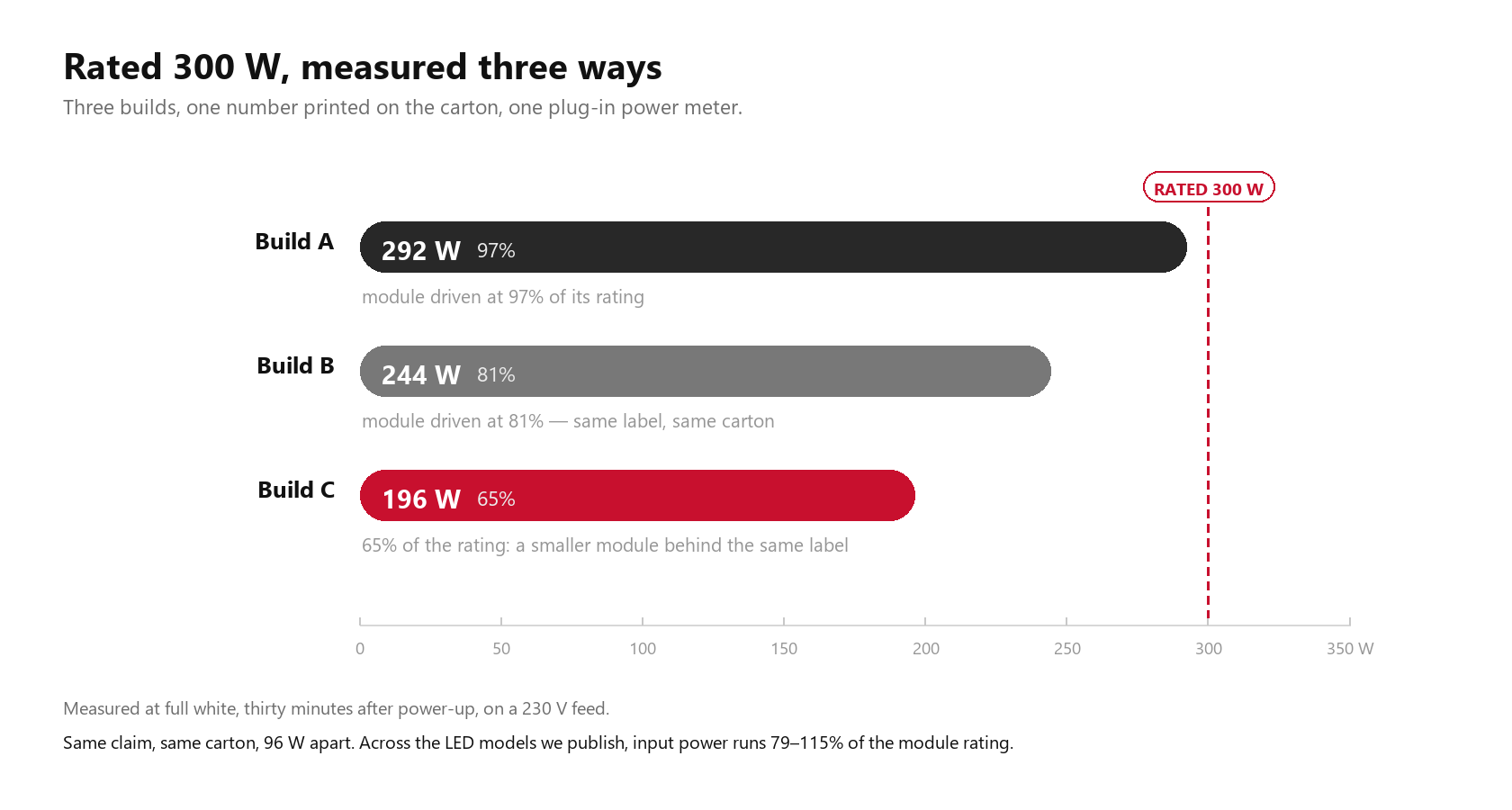
The number on the carton usually comes from the maximum rated dissipation of the LED module — the chip's own ceiling, quoted at a drive current and junction temperature that many fixtures never reach. What the fixture actually draws is decided one stage later, by the driver. Against the same 300 W module, a driver can be set to 300 W, to 245 W or to 200 W; a meter at the wall then reads roughly 292, 244 or 196. Each of those is a defensible engineering decision. Only one of them matches what the buyer thinks they ordered.
Where the gap grows:
- Driver setting. The cheapest power reduction available: change one resistor, keep the label. Twenty per cent less light, twenty per cent less heat, twenty per cent less cost in the module's operating life — and no change to the spec sheet.
- Bin selection. A lower-bin module at full drive produces roughly what a top-bin module produces at 85% drive, for less money and more heat. The wattage is honest; the lumens per watt are not.
- Carried-over labels. "300 W" is sometimes inherited from the previous generation's module, or is an "equivalent" figure left over from the domestic-lamp era. Open the fixture and it is a 200 W module, and it always was.
- Peak versus continuous. A fixture described as 300 W may reach 300 W only in a boost mode that the thermal design cannot sustain. It settles at 240 W after twenty minutes and stays there for the rest of the show.
- Lumen maintenance. Quoted output is at hour zero and 25 °C. Measured at 1,000 hours in a hot room, a cheap module can be down 15% where a good one is down 4%. Same wattage, less light, and nobody re-measures.
| What the carton says | What a meter reads | What it means |
|---|---|---|
| 300 W module rating | 237–345 W | 79–115% — the range our own LED models sit in |
| 300 W module rating | 196–237 W | 65–79% — below anything in that range; ask which module it is |
| 300 W module rating | under 196 W | A different, smaller module |
| 300 W, undefined | 300 W, low lux at fixed distance | The figure is input power and the bin is low — the loss shows as heat |
What should the number be? LED input power sits close to the module rating, which is what makes the arithmetic useful. In the LED models we publish specifications for, input power runs between 79% and 115% of the module rating: a 19×40 W bee-eye at 79%, a 7×40 W zoom at 100%, a 12×25 W wash at 87%, a 10×80 W beam at 94%, and a 12×40 W model at 115% once the auxiliary ring and the motors are counted. Above 100% is ordinary — driver losses, fans, motors. Below 80% needs an explanation, and the explanation is usually a smaller module.
That gives a rule rather than a test: a fixture drawing 65% of the wattage printed on its carton is not a 300 W fixture running gently. It is a smaller module under a larger label. There is no reading of the number under which it is what was ordered — not the module rating, not the whole-fixture input.
The honest form of that disclosure is simple: publish the light source figure and the input power side by side, and say which is which. Our datasheets carry both, because the second one is the only one a buyer can check with a meter.
None of this shows up as a failure. A fixture at 65% of its label still strikes, still pans and tilts, still clears a visual check in a bright room. It simply does not cover the position that was specified for it, and the shortfall is discovered on the first night of a tour, at the far end of the throw, with the rig already hung.
How to settle it in ten minutes. A plug-in energy meter on a single fixture at full white settles the input side. A lux meter at a fixed distance settles the output side. Divide the second by the first and you have lumens per watt, which is the only figure that lets two fixtures be compared honestly. Do it on the sample, not on the sheet.
Then ask for one sentence in the order: the measurement basis for the wattage. Which of the three numbers is being quoted — the light source rating, the input power at the wall, or the output — and under what conditions: full white, how long after power-up, at what supply voltage. That is a request for a definition, not a lab report, and it costs nothing to write.
It is also the most effective filter in this article. A supplier who can state the basis has measured the fixture it is selling. A supplier who cannot has been copying a number from a module datasheet, and the number on the carton is the only place it has ever appeared.
6. The Power Supply: The First Place Money Comes Out
This is the single most common downgrade, and the one with the worst failure mode.
A branded, active-PFC supply with a documented surge rating costs several times what an unbranded supply of the same wattage costs. On a fixture in this class the difference is typically RMB 80–220 per unit — often the entire margin on a competitive quote, and the difference between a fixture that survives a dirty mains feed and one that does not.
What changes when the supply is downgraded:
- Efficiency. Two or three points of efficiency is 20–30 W of extra heat inside a sealed box, which is heat the thermal design now has to remove.
- Inrush and surge tolerance. A marginal supply does not usually die on day one. It dies on the twelfth power cycle after a storm, in a room with no spare fixture.
- Failure mode. A good supply shuts down and recovers. A cheap one takes the driver board with it.
- Service life. Electrolytics age by temperature. A supply running hotter than it was designed for is a five-year part being asked to do three.
None of this is visible from outside. The brand is visible on the label — if the factory will tell you what it is, which is the subject of section 11.
7. Sheet Metal: The Part Buyers Never See
Inside the housing, most of the structure is folded steel or aluminium that nobody photographs. It is also where a determined cost reduction is easiest to hide, because the outside of the fixture does not change at all.
What actually gets cut:
- Gauge. 1.5 mm becomes 1.0 mm, or 1.2 mm becomes 0.8 mm. The fixture still looks the same on a truss; it flexes more when you hang it, and the brackets transmit more vibration into the optical bench.
- Bracing and internal brackets. The stamped ribs and the small brackets that hold the driver, the fan shroud and the pan mechanism are the first parts to disappear. Nothing fails immediately. The fixture becomes noisier, and connectors work loose over a year of transport.
- Shielding and grounding. A shielded driver compartment and a proper earth bond cost money and appear in no datasheet. Removing them is invisible until someone puts the fixture next to a wireless receiver, or until an insulation test fails.
- Coating. Zinc plating thickness, powder coat adhesion, and whether edges are deburred. Thin coating on a coastal install is a corrosion problem in year two, not year five.
- Fasteners. Fewer screws, shorter screws, lower grade. A machine that skips four screws per unit saves seconds; the panel that rattles at 60 Hz becomes the customer's problem.
- Air sealing around the optical chamber. A gasket that is omitted, or a seam that is not sealed, means the optical path draws unfiltered air from the driver compartment instead of from the intake grille.
That last item connects directly to service life. A dirty optical path is what shortens the cleaning interval and eventually kills output, and our preventive maintenance guide exists precisely because most "electrical" failures in the field start as an airflow and sealing problem.
8. Lens Material and Consumables
The lens in front of the LED decides what the beam looks like, and it is one of the quietest places to save money.
- Material. PMMA, PC or glass. PC is tougher and yellows faster under heat and UV. PMMA transmits better and scratches more easily. Optical-grade glass costs more and holds transmission for years. Recycled or non-optical resin is cheaper still, and the beam edge tells you about it.
- Coating. A single-layer anti-reflective coat and a multi-layer broadband coat differ in transmission by several percent — invisible on one fixture, obvious across a rig, and the difference between a clean white and a slightly grey one.
- Wall thickness and moulding quality. Thin lens walls distort under heat. Sink marks and flow lines in the moulding scatter light in a way that reads as a soft, slightly doubled beam edge.
- Gobos and colour flags. Photo-etched coated glass against stamped steel is not a small difference, and it is visible the moment a pattern is projected at 15 metres.
Then the consumables, which is what "auxiliary materials failed specification" usually means in practice:
- Thermal interface. A proper phase-change pad or a filled silicone grease, applied at the specified thickness. A thin smear of general-purpose grease, or too little of the right one, raises the LED junction temperature by 10–15 °C and takes years off the module without changing a single specification.
- Wiring. 0.75 mm² becomes 0.5 mm². Fine at 20 °C in a showroom; warm and lossy at 45 °C after four hours.
- Connectors. Branded latching connectors become lookalikes with thinner plating. The failure appears as an intermittent fault that costs a service visit to find.
- Seals and gaskets. EPDM against a cheaper compound that hardens in two summers. On an outdoor fixture this is the difference between IP65 and "was IP65 when it left".
- Fans. Bearing type and blade balance. A cheap fan is audible from the first week and seizes in the third year, and it is the only thing standing between the LED and thermal derating.
None of these items is expensive individually. Together they are a meaningful share of the build cost — and collectively they are the difference between a fixture that is still on spec at year five and one that is not.
9. Assembly, Burn-In and Test
Two more decisions that are not parts at all:
Assembly discipline. Cable routing, torque on the heatsink, connector seating, the order things are tightened in. A trained assembler takes longer. The consequence of skipping the discipline is not a visible defect at dispatch — it is an intermittent fault in month seven, which the customer pays to diagnose.
Burn-in. Two hours of soak screens some infant mortality; twelve hours screens most of it; forty-eight hours with a photometric check screens nearly all of it. Every hour on that rack is cost with no part number attached, which is why it is the first thing removed when a price has to come down. The customer never sees the rack. They see the absence of a dead-on-arrival fixture in the first shipment — or they see three.
Test. Whether every unit is measured or a sample, and whether the measurement is recorded. A photometric check per unit is how a factory knows its own consistency, and it is the reason some factories can promise that unit fourteen matches unit one.
10. Where the Cheaper 30% Actually Comes From
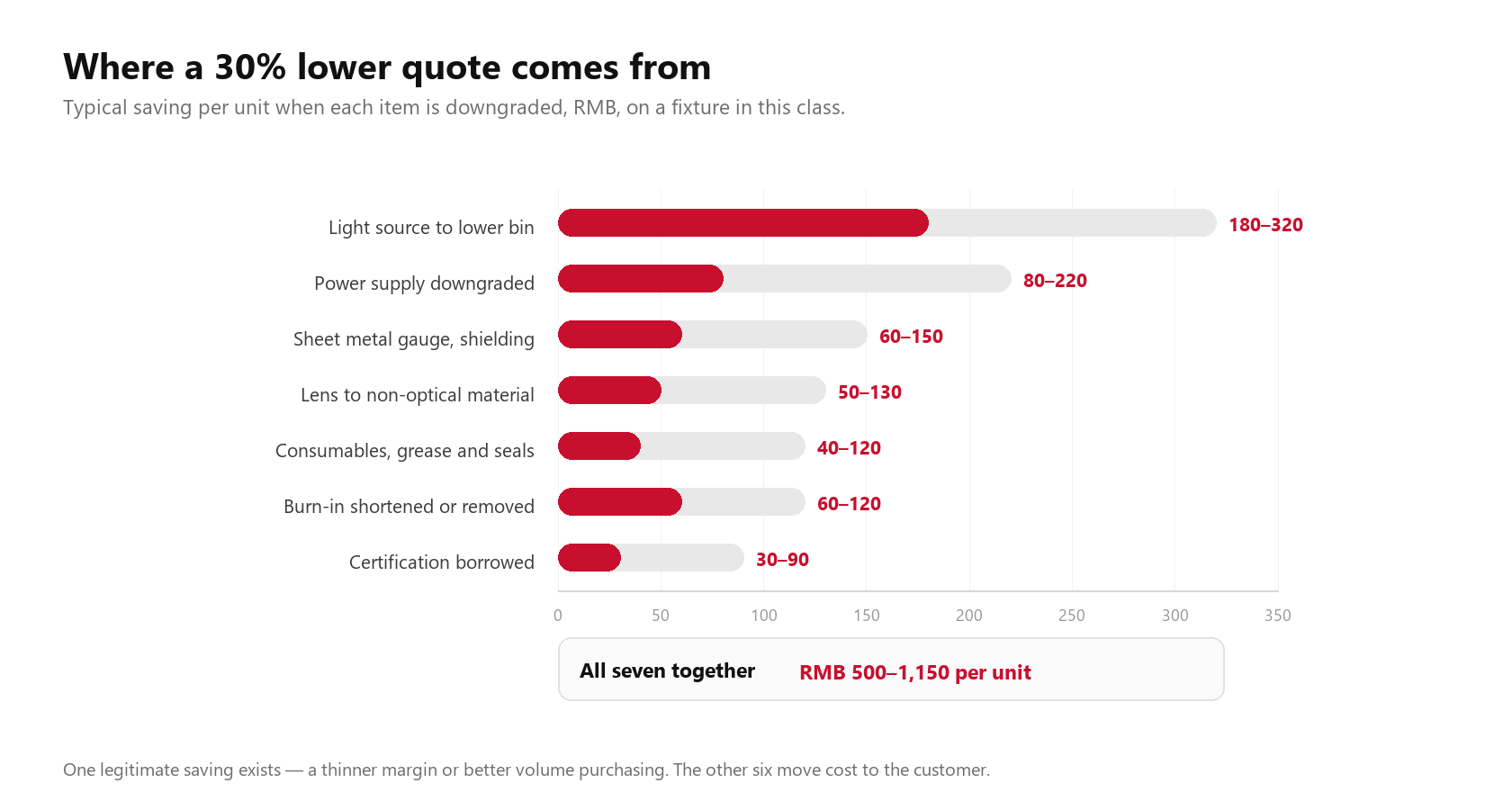
When a quote is materially below the market for the same stated specification, the saving has to be taken from somewhere. In order of how often it appears:
| What was cut | Typical saving per unit | When the customer finds out |
|---|---|---|
| Power supply downgraded | RMB 80–220 | After a mains surge, in the worst possible week |
| Light source to lower bin / unbinned | RMB 180–320 | When eight fixtures are compared in white |
| Sheet metal gauge, bracing, shielding | RMB 60–150 | Transport rattles, earthing test, RF interference |
| Lens to non-optical or uncoated material | RMB 50–130 | Beam edge softness, and 10–15% less output |
| Consumables (grease, wire, connectors, seals) | RMB 40–120 | Year two to four — thermal, corrosion, intermittents |
| Burn-in shortened or removed | RMB 60–120 | Dead on arrival, or in the first month |
| Certification borrowed or implied | RMB 30–90 | Customs, or a tender that asks for the number |
Add the middle of those ranges together and you get RMB 500–1,150 on a fixture in this class — which is where a 30% lower quote comes from. It is not a mystery, and it is not a different business model. It is seven line items, each reduced.
One item is legitimate: the factory that simply operates on a thinner margin, or builds at larger volume and buys parts better. That is a real advantage and a real reason to buy. The other six move cost from the supplier's books into the customer's, and they move it into a column that is much harder to see.
There is an eighth saving that does not appear in the table, because it is not a reduction at all: leave every part as it is, drive the module well below its rating, and keep the label. It costs nothing to do, it is invisible in a photograph, and it is larger than any single line item above. That is section 5, and it is worth re-reading before any of the rest.
11. Ten Questions That Still Work Without a BOM
A quotation that lists a model number and a price cannot be compared with another that does the same. You do not need a bill of materials to fix that — you need ten answers, in writing, about the items that actually move.
- Light source — brand and part number, brightness bin, CRI, and whether batches are colour-matched.
- Power supply — brand, model, active PFC yes or no, surge rating.
- Sheet metal — gauge of the main bracket and the driver tray, and whether the driver compartment is shielded and separately earthed.
- Optics — lens material (PMMA, PC or glass), coating, and focus tolerance.
- Thermal — heatsink mass in kilograms, fan brand and bearing type, thermal interface material specified.
- Wiring and connectors — cable cross-section, connector brand, strain relief method.
- Motors — stepper type, open or closed loop, encoder fitted or not.
- Burn-in — hours, and whether every unit or a sample.
- Test — which measurements are recorded per unit, and can you see a sample report. Ask specifically for input power at full white and centre-beam lux at a stated distance, on the actual unit, not on the datasheet.
- Warranty and spares — what is covered, for how long, and which parts are held in stock.
A supplier that answers eight of these precisely is quoting a product. A supplier that answers three vaguely is quoting a number, and the product has not been decided yet.
Note that none of the ten asks for a part number list, a supplier name or a cost breakdown. Those are procurement data, not product data — see the next section.
12. Why We Do Not Hand Over a BOM
Since this article is about what is inside the box, it is fair to say what we will and will not put in writing.
We do not issue a BOM with a quotation. No factory does, in a form that would survive a price negotiation: a bill of materials carries supplier names, internal part numbers and purchase prices, and handing that over is handing over the supply chain. Buyers who ask for one usually want something else — evidence that the parts are what the seller says they are — and that can be given without the document.
What we will put in writing:
- The grade of every item in section 11. Light source brand and bin, power supply brand and model range, lens material and coating, sheet metal gauge, heatsink mass, motor type, burn-in hours.
- The light source figure and the input power, side by side. Which number is which, how each was arrived at, and what conditions it assumes. If a model is described as 300 W, the sheet says what it draws at the wall.
- What changes when a cheaper build is requested. Not "we will find a way" — the specific line, the specific saving, and what it costs the customer later.
- A sample to test. Send it to a lab, put it next to the fixture you already own, measure it at a fixed distance. A photometric comparison against a known unit is worth more than any document.
- A teardown. For an order of any size, open a unit and look at the sheet metal, the supply label, the lens edge and the grease film. We would rather you did that than trust a spec sheet, ours included.
- Test reports and certificate numbers for the exact model, when the project needs them.
What we will not do is quote a price and then quietly decide which of the seven items in section 10 to reduce, or write a wattage on the box that the driver does not deliver. If a project needs a lower number, we will name the trade-off — a smaller heatsink, a lower-binned module, a shorter burn-in — so that the saving is a decision the buyer made, not something that happened in a factory.
That is the honest version of price transparency in this industry: not a document, a conversation with specifics in it.
13. What "Same Housing" Does Tell You
It would be unfair to end on the implication that a public housing means a compromised fixture. It carries real information:
- The outline and rigging are proven. Thousands of units have hung from that mould.
- Seals and gasket seats are known. A housing with a tested gasket channel is better than a novel one, and for outdoor models this matters more than most specifications.
- Spares and accessories are findable. Brackets, covers and clamps are not proprietary.
- The IP rating of the housing is a starting point, not a result. What the assembled fixture achieves still depends on the gland, the cable entry, the sealing of the optical chamber and the assembly discipline — see our IP65 vs IP66 guide.
What it does not tell you is everything in sections 4 to 9. A housing is a chassis. It is the cheapest way to look like a serious product and the least informative way to judge one.
And it tells you nothing at all about section 5. A fixture at 65% of its stated wattage has exactly the same outline, the same rigging points and the same gasket seats as one at 100% — which is why the label is the one place where a photograph is not merely uninformative but actively misleading.
14. Where the Money Comes Back
The arithmetic that matters is not the unit price. It is the unit price plus what the fixture costs after it is installed.
Take a 24-unit rig and a 30% lower quote. Assume the saving is real and stays in your pocket at purchase. Now price what the seven cuts make more likely over three years:
- One power supply failure per year across 24 units, at a downgraded supply's typical rate: the part, the labour, and the labour of getting to the fixture at height.
- One fixture out of service on a Saturday night: a replacement, an emergency call-out, and a client who remembers which supplier was recommended.
- Output loss you cannot invoice anyone for. By year three the cheaper rig is measurably dimmer and slightly less white than a rig bought the same month, and the only visible symptom is that the room needs a refresh sooner.
- A shorter cleaning interval, because a thinner heatsink runs hotter and a compromised optical seal pulls dirty air. Our maintenance schedule shows how much of the annual service load is driven by heat and dirt rather than by hours.
None of this argues for buying the most expensive fixture. A theatre running 15 hours a week in clean air does not need a touring-grade heatsink, and paying for one is not diligence. It argues for knowing which line of the specification you are paying for, so that a 30% saving is a decision rather than an accident.
Frequently Asked Questions
Why do two moving heads with the same public housing have such different prices?
Because the housing is a bought-in part with no tooling cost to recover, and it is roughly 9–14% of the fixture. The price is decided by what is inside: the grade and binning of the light source, the power supply, the sheet metal gauge and shielding, the lens material and coating, and the consumables — thermal grease, wiring, connectors, seals. Two factories can share the same box and differ by 40% on those items alone.
Is a public-mould housing a sign of low quality?
No. Public housings are normal in this industry, and some of the most reliable fixtures on the market use one. The mould fixes the outline, the rigging points and the gasket seats — it says nothing about the light source, the supply or the sheet metal inside. Judge those, not the shape.
Can a 300 W moving head actually deliver less than 300 W?
Yes, and it is more common than most buyers expect. The label usually quotes the maximum rated dissipation of the LED module, while the driver decides what the fixture actually draws. The same module can be driven at 300 W, 245 W or 200 W, and the carton says 300 W in all three cases. Input power for LED fixtures normally lands between 79% and 115% of the module rating, so a 196 W reading under a 300 W label is not a gently driven fixture — it is a smaller module. It still strikes, pans, tilts and passes a visual check; it simply lights a 12 m throw like the smaller fixture it is, and you find out on the first night of a tour. A plug-in energy meter at full white settles it in ten minutes.
How can I check quality if the supplier will not give me a BOM?
Ask ten specific questions instead: light source brand and bin, power supply brand, main bracket gauge, lens material and coating, heatsink mass, cable cross-section, motor type, burn-in hours, per-unit test records, and what spare parts are held. Then look inside one unit, or send a sample to a lab. A photometric comparison against a fixture you already trust beats any document.
What fails first on a cheaply built fixture?
The power supply, in most cases — a downgraded supply dies after a mains surge rather than at first power-up. After that, the light source drifts in colour against its neighbours and loses output faster than specified, and the consumables decide what happens in year three: hardened seals, dried thermal grease, worn connectors. None of these is visible in the first week, which is why the first week is a bad time to judge a fixture.
Comparing two quotes for the same-looking fixture? Send both build sheets — or just the model numbers — and we will tell you which lines differ, what the difference costs to build, and which of them actually matters for your venue and duty hours.